
Arpoador Collection
Dinner at Tomate's: Sushi in a Cook's Home in Arpoador
| Tomate opens his home. You stay for dinner. That is how the evening works in Arpoador, the fishing village in Tutóia where a cook hosts twelve people at most in his own living room, decides the menu on the day and has no intention whatsoever of rushing anyone. The most honest proof is not a photo of a dish. It is a couple asleep in an armchair, barefoot, in front of a wall of records, after three hours at the table. |
A restaurant that is not a restaurant
Tomate is the cook's name and also the name the village uses for his house. There is no sign on the door and no printed menu. There is a long wooden table, chairs for twelve and a host in cap and apron who serves what he has cooked with his own hands. The format is rare and therefore precious: dinner at the home of someone who cooks very well, without having to be his friend before you sit down.
The room tells the story
The house is a biography hung on the wall. Eric Clapton in black and white, David Bowie on a Sound and Vision 1990 poster, U2, Pearl Jam, Jimi Hendrix and Ozzy Osbourne. Bar signs with the recipe for a rabo de galo and a caipirinha. A floor to ceiling wall of CDs and DVDs, stacks of records nobody tidied for the photo, an old stereo on a tree trunk, a dartboard, a glass door bar fridge from another era. In the middle of it all hangs a red kanji, the only hint, before the food arrives, that the night will end in Japan.
None of it is a set. It came from no catalogue and no decorator. It is a man's life on display in his living room, and guests dine inside it.
First, the bar
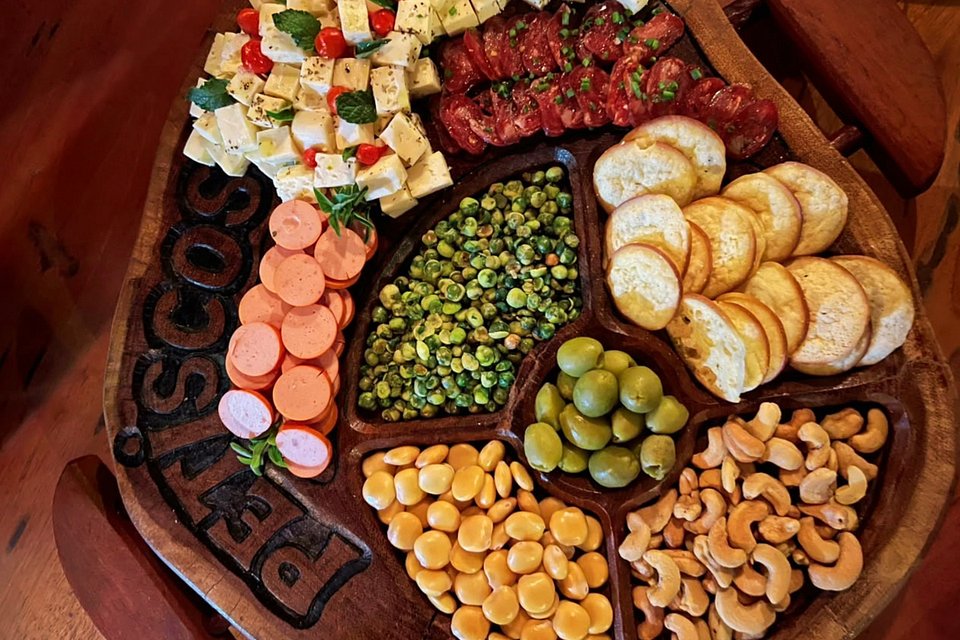
The welcome is not Japanese. It is a hand carved wooden board with the word PETISCOS, Portuguese for bar snacks, cut into its rim, and what comes on it belongs to a Brazilian bar table: cubes of coalho cheese with cherry tomatoes and mint, sliced calabresa sausage with chives, lupini beans, cashews, green olives, crisp toasts. Beside it, a platter of skewers with cheese, salami and quail egg around a mound of black olives. The only nod to Japan is the wasabi peas, green and crunchy in the middle of the board.
Tomate presents it all himself, leaning over the table, explains what is there and goes back to the kitchen. It is the start of an arc that runs through the whole evening: it opens like a Brazilian bar and closes like a Japanese table.

The menu is whatever the sea brought
There is no fixed menu. What reaches the table depends on what came in that morning. In the middle of the afternoon, Tomate sends the concierge the list of what he will serve that night, and that is how guests learn what they will eat. The dishes in this text come from recent evenings; other days bring a different fish, a different arrangement, a different dessert.
On one of them, the table received crab claws set in a circle around a fresh vinaigrette of tomato and pepper, scattered with chives. Crab is an old part of the Maranhão coastal table, a coast that lives between the sea and the mangroves. Then came harusame, whose Japanese name means spring rain, after the translucent threads of the noodle. At Tomate's it is served cold, with golden shrimp, carrot, sesame and mint picked in the garden.
Then, Japan
The technique is Japanese; the ingredients are local. The shrimp sushi arrives in rows, each piece with the shrimp's tail curling out; around it, hosomaki and uramaki with sesame, pickled cucumber and ginger. There is no pretence of a big city Japanese restaurant. There is a cook who learned the technique and chose to apply it to what the Maranhão coast delivers.

From the pot straight to the table
The main course is not plated. It comes in the pots it was cooked in, and everyone helps themselves: gohan, Japanese rice; kare, the curry Japan adopted in the late nineteenth century and turned into home cooking; and robalo, a snook that fishermen bring in from the bay of Tutóia, steamed in a bamboo basket with broccoli and chives. For those who do not eat fish, there is filet mignon.
To finish, coconut mousse and the dish everyone talks about afterwards: a wasabi brigadeiro. Nobody believes it. Until they taste it.
Nobody falls asleep in a restaurant
Three hours sounds like a long dinner until the first night at Tomate's. Nobody clears the plates in a hurry, nobody brings the bill before its time. Some stay talking at the long table, some move to the armchairs in the living room, and some fall asleep. It is not the host's neglect. It is the best review a home can receive.

How to book
Dinner hosts up to twelve people, from 7 pm to 10 pm, any day of the week, depending on Tomate's schedule. The places are, quite literally, the chairs he owns. Bookings go through the concierge, who confirms the date, shares the price and sends the menu for the night. Dietary restrictions should be mentioned when booking.
Getting to Arpoador
Arpoador is a fishing village in Tutóia, Maranhão, at the end of Alameda dos Velejadores, the gateway to the Pequenos Lençóis. It lies 343 km from São Luís and 134 km from Parnaíba, and the last 13 km run along the beach, by 4x4 only. The AR.Co Concierge arranges every detail: 4x4 vehicles with qualified drivers, helicopter charter and ground assistance.
Frequently asked questions
Do I need to book dinner at Tomate's?
Yes. There are twelve places a night at most, and bookings are made through the concierge, who confirms the date with Tomate.
What is on the menu?
There is no fixed menu. It is decided on the day, based on what came in from the sea, and sent to the concierge in the middle of the afternoon.
Is there an option for those who do not eat fish?
Yes. The main course can be served with filet mignon. Other restrictions should be mentioned when booking.
Where is it?
At Tomate's own home, in the village of Arpoador, Tutóia, Maranhão. The concierge shares directions when the booking is confirmed.
Would you like one of the twelve chairs?
Speak to our concierge
| Arpoador Collection. Stays, properties and experiences. |